In 2018, I was incredibly lucky to tick off one of the things I wanted to do before I died—at just 23: sail across the Atlantic. The nautical adventure itself could fill a book; I’m leaving here a homemade documentary I filmed and edited in case anyone curious has some time to spare (40k views on YouTube—no small feat), but today I wanted to write about something specific that happened during those weeks.
Back then, Starlink still had no satellites in orbit (the first were launched in May 2019), satellite phone plans were unaffordable… But even a minimal plan is essential in these cases, for whatever might happen out there in the middle of nowhere. Our plan basically allowed us to receive and send one email a day.
The one we received was the weather report—no surprises there, and very useful. But, in a burst of inspiration, we decided that the one we sent back would be a kind of logbook for our families, for their peace of mind and entertainment. A plain-text logbook—our data plan couldn’t handle attaching images or videos.
Specifically, we sent the email to my sister, who then shared it using an email marketing tool that I doubt any reader under 25 would even know: Tiny Letter. We created the list just two days before setting off—20 people at most, all immediate family.
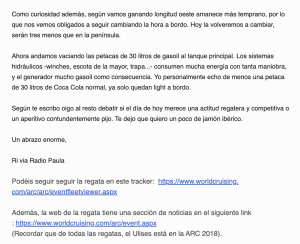
By the time we reached the Caribbean just 16 days later, the list had multiplied by 6 to around 120 people (I don’t remember the exact metrics—it could well have been 200—but I can’t check anymore because Mailchimp, Tiny Letter’s biological parent, shut the platform down several years ago); and that’s not counting all the people who couldn’t subscribe but had the emails forwarded to them by others.
It is important to add context at this point: back then, newsletters were neither popular nor widely known. You would not believe how many people replied to the sending address as if there were someone on the other side writing an email specifically to them and no one else…
We broke every tip any guru would give today: we sent a daily email—an absurdly high frequency; plain text, with no photos, no videos, no colors; written to a family recipient who was not the majority of the eventual readership; sent from a Gmail account, with no custom domain; and there wasn’t even a page to subscribe… My sister manually subscribed everyone who asked whenever she could, or shared a link to what at the time was a sign-up form (which would be something to see compared to today’s…).
The virality of a good story.

The story behind DRIZA’s newsletter, Agencia Agencia, and why we named it Cónclave
Off the back of that experience, Agencia Agencia (the original name under which DRIZA was founded) decided to diligently write a monthly email about our journey as an agency, which generated very similar reactions. To my surprise, people still remember those emails from the early years—friends of friends who stop me on the street, and that is the first thing they mention or associate with our brand. Now that is brand recognition…
Day-to-day operations, our growth, and the inevitable shift to a brand that better reflected our differentiation as a consultancy rather than an agency forced us to pivot slightly: we toned it down, decided to include three different writers per newsletter, cut back on the memes, and include more photos.
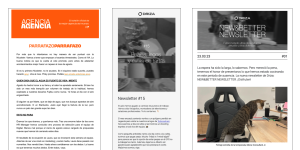
Today we are pivoting even further away from the original family-focused approach, toward a more technical newsletter—driven by the natural pull of our audience, clients, and team; and getting ahead of a market trend that is begging for someone to add value and less filler content. A newsletter with real takeaways—the kind that have been worked on and studied, not the kind ChatGPT can list for you—without losing the voice that defines us. Bite-sized insights that could come out of a conclave of true experts.
Newsletters as a marketing and profitability channel: the Morning Brew case
Beyond our DNA, this bet has an economic foundation. Take Morning Brew as an example: in 2014, a couple of friends started a daily newsletter summarizing the day’s top news, almost as a personal exercise to keep up with current events. In 2020, Insider Inc. acquired a majority stake at an estimated valuation of $75M (Source). In 2022, they reached 4M subscribers—not bad for writing a few emails.
In an ecosystem of “walled gardens,” battles over data among unpredictable multinationals, GDPR and disdain for cookies—going as far as the TikTok ban in the U.S.—building loyal communities is almost an act of self-defense: defending the efficiency of future marketing channels. Newsletters (or broadcast tools—I’m lumping communities, broadcasts, and alerts into the same bucket) are still undervalued. Without trying to whet anyone’s appetite, the number of success stories we hear at DRIZA from entrepreneurs who nurture this channel is staggering.
Newsletters as an industry: the providers
Do not get up from your chair—there’s more. Morning Brew’s story didn’t end there: not satisfied with their whopping subscriber base, they also founded Beehiiv in October 2021, which raised $33M in a Series B in April 2024, already with $13M ARR, a 450% year-on-year increase—and it is estimated that in 2023 the platform was sending emails to 50 million unique readers, just to add another metric.
If you don’t know Beehiiv, you should. By slightly shifting the focus in an industry we might all have written off as saturated, they found a goldmine: while Mailchimp and many others focus on the email-sending technology itself, Beehiiv focuses on being a creator-first platform, offering built-in monetization features such as paid subscriptions or sponsored content, referral programs, and collaborations, among many other pillars. Details that make the difference.
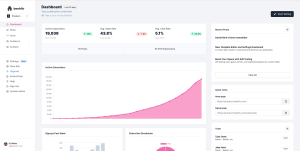
As an anecdote, I do think it is worth dedicating two sentences to ConvertKit, another provider in the space that brings back the close, family feel of our logbook, which publishes all its metrics, in bulk, on a dashboard. Hardcore build in public. . $43M ARR—not too shabby.
They are only a couple of industry references, but they represent the channel’s promising future well.
Some of the best newsletters we follow
I’ll use the space this page gives me to recommend a few newsletters we read here frequently, starting with the newsletter that, by definition, brings together the best recommendations and tool discoveries in the space: Recursia by Bisiesto Estudio.
From the startup world, of course, we follow Dealflow religiously; we also read Product Hunt launches daily, Chartr’s daily email, and the most meticulous of them all: Chief MarTec.
The future has stories—so do emails
When they are well designed, newsletters go beyond infoxication. They build relationships, foster loyalty, and create lasting impact.
Even if formats and strategies change, the core remains the same: communicating authentically something that brings value, entertainment, or both to the reader. The best stories don’t need big gimmicks—just clarity and that spark that makes a reader stay. And that is the true value of this channel.