If you own an e-commerce business and have ever experienced a cash flow shortage precisely when sales were highest, you have likely encountered Revenue Based Finance, or RBF for short.
The promise sounds appealing: they advance you capital, you don’t give up equity, and you repay the money as you sell. In other words, less bank involvement, fewer investor pitches, and, in theory, more flexibility. So far, quite attractive.
However, as with almost any financial product that sounds too convenient, the important question is not just how it works, but what it truly costs and for what type of business it is suitable.
First, the basics: What is RBF?
RBF is a financing model where a company advances you capital today in exchange for repayment with a commission, typically linked to a percentage of your future sales.
It is not a classic bank loan (no fixed installments or annual interest), nor is it equity (you don’t sell a part of your company). Wayflyer, for example, adds a fixed commission of 5% to 10% and allows repayment through fixed amounts or a percentage of sales. Shopify Capital operates with repayment based on daily sales and a maximum term of 18 months.
Simply put: you don’t pay with shares; you pay with future revenue.

Source: Own simulation based on Wayflyer’s public fixed fee structure and Shopify Capital’s communicated maximum term.
A non-negotiable requirement: technological integration
Here is one of the most frequently overlooked aspects: RBF does not work without data. For a provider to finance you, they need to see your sales in real-time.
This means directly connecting your e-commerce platform (Shopify, WooCommerce, Amazon Seller Central…) with the financier’s system. There is no deal without access to this data. Wayflyer, ClearCo, and Shopify Capital base their decisions on the automated analysis of your sales history, margins, returns, and marketing metrics.
That is why RBF works well for e-commerce and makes no sense for a business without a trazeable digital presence. If you don’t have data, you don’t have RBF.
What is it for? (And what is it not for?)
RBF particularly shines when capital is allocated to short-term marketing investments with a quick and predictable return: Paid Media campaigns (Meta Ads, Google Ads, TikTok Ads) with a proven ROAS, where you know that every euro invested returns more within weeks.
The logic is clear: if you finance a campaign that generates sales in 2–4 weeks, you can repay the capital with those same sales. The cycle closes itself.
Conversely, RBF is not designed for:
- Purchasing stock without clear rotation or new products without a history.
- Covering fixed operating expenses (salaries, rent, software).
- Financing channel tests without prior return data.
Any use that does not have a direct and measurable short-term return.
If the money is not going to generate additional sales within a few weeks, the cost of RBF becomes a burden. It is not money for structural expenses but rather fuel for campaigns that are already working.
What about seasonality?
If you sell more during Black Friday, Christmas, or specific campaigns, a model that is repaid based on sales has intuitive appeal: in good months, you pay more; in slow months, less.
The important nuance: seasonality is not the same as financial health. If your sales peak comes with good margins and controlled returns, RBF can help you scale that campaign. If it comes with aggressive discounts and soaring CAC, the model only makes it more evident that you sold a lot but retained little.
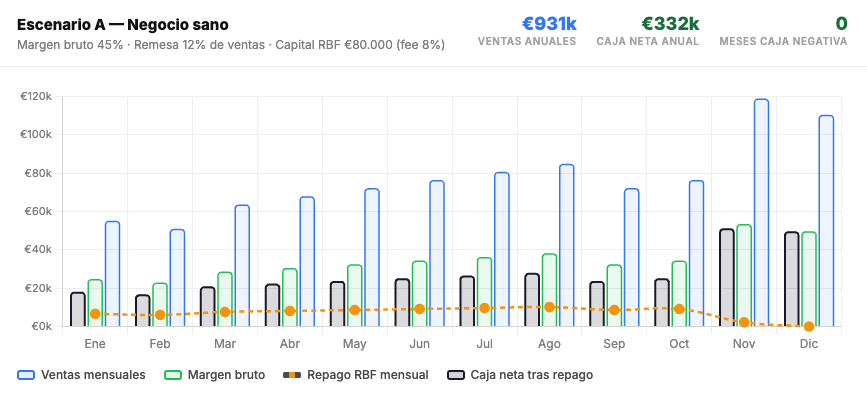
Source: Own simulation based on Wayflyer’s public fixed fee structure and Shopify Capital’s communicated maximum term.
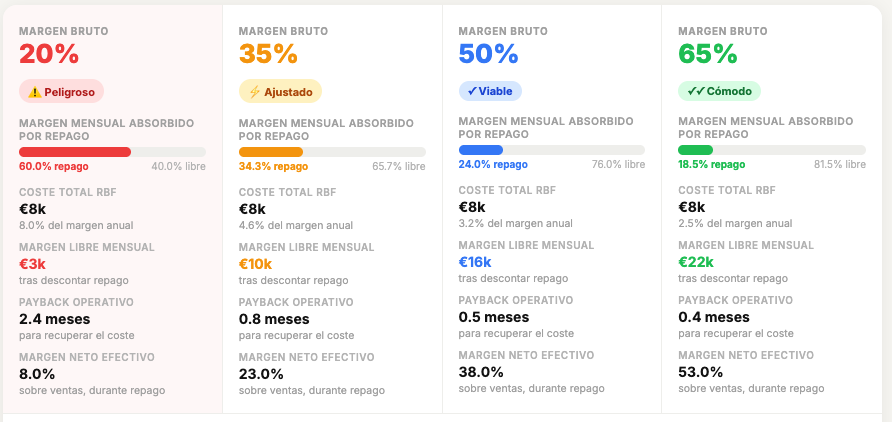
The governing variable: the margin
The better your margin, the more sense RBF can make. This type of financing works especially well when additional capital rotates quickly and generates a clear return: reinforcing profitable acquisition campaigns or covering a short cash flow gap without touching equity.
Conversely, if you operate with low margins, expensive logistics, or weak returns on paid media, RBF begins to lose its appeal. Not because the product is flawed, but because every euro of future sales was already too committed before signing anything.
So, when does it make sense?
It makes sense when:
- You have predictable sales and sufficient margin.
- The capital goes directly to paid media with a proven ROAS or to scale an already successful campaign.
- You do not want to dilute equity and need speed.
- Your technological stack allows for real-time data integration.
It makes less sense when:
- You do not fully understand your unit economics.
- You grow through discounts that erode your margin.
- The use of capital does not have a clear return within a few weeks.
- You do not have a digital presence with trazeable data.
“RBF is not ‘cheap money’. It is fast, flexible money, and in the right context, very useful. The question is not whether there is a perfect financing formula. The question is whether yours aligns with how you sell, how much margin you retain, and how predictable your business is.”
Sources