The decision of how a startup should manage its opportunity pipeline is a decision that must be carefully considered, not only from a strategic or financial perspective, but also from a digital adaptation perspective. If you are an entrepreneur or lead a startup, you have likely faced the dilemma of how to efficiently manage your interactions with customers and prospects without losing data traceability, being able to interrelate the greatest number of areas and tasks possible at the best price.
If you have been at this point, you have surely asked yourself: Should I opt for a generic CRM that integrates all the necessary tools, or should I choose a CRM specific to my sector and opt for specialized tools to complement it?
The answer is not simple, as it depends largely on your financial and technological capacity, but above all on your interest in obtaining data traceability (which I hope is high 😝).

Generalist CRMs
Generalist CRMs were created with the objective of democratizing business software, making it accessible, offering all-in-one tools that would allow centralizing marketing, sales, and customer service with a pioneering and comprehensive approach compared to other more traditional CRMs. So far, everything is clear.
Over the years, companies like Zoho, Salesforce, or HubSpot have been carrying out operations always focused on innovation and digital adaptation. Acquiring and developing tools that allow integrating all types of connections and custom developments. Offering clients pioneering and adaptive solutions. However, the customization, knowledge, technical implementation, technological dependency, and pricing that this type of software requires for some companies is excessive.
Sector-Specific CRMs
Sector-specific CRMs, on the other hand, are designed to respond to specific needs. This type of CRM responds to particular needs, which depending on the type of business can become valuable options compared to a generalist CRM.
Many industries, such as real estate, healthcare, or automotive, have historically depended on personal and traditional business relationships. As their sector has become digitized, specific needs have begun to exist that have motivated the development of this type of CRM. This need makes these CRMs slightly less competitive in terms of digitalization, as they are usually CRMs that develop their product on the go and do not always respond to all the traceability needs that a client may require.
Specific Cases in the Aesthetic Medicine Sector
The aesthetic medicine sector is undoubtedly a booming sector; I keep seeing clinics everywhere. Technological innovation and advancement, greater social acceptance of this type of treatment, and the impact of social media and image culture have meant that there is increasingly more competition in this cutting-edge market.
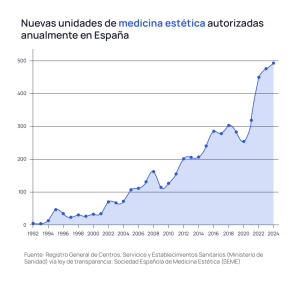
We all know that aesthetic medicine, health, or beauty businesses have fundamentally been sectors that have always functioned without the need to digitize. Mostly, local businesses have emerged that have adapted practical dynamics that did not make the implementation of digital tools necessary.
Today, the boom in this type of business and the broad capacity to expand online has meant that the basic tools and software used by this sector need to modernize toward more complex technological needs. The extra challenge that this type of business also faces is that they have a complex operational particularity, as they function based on appointment requests.
And I know you are thinking that it is absurd and very simple. But they have numerous inputs to consider that niche CRMs are not currently able to resolve.
Data Protection vs. Acquisition?
One of the errors we have most detected in database management in this type of sector is the lack of differentiation between patient management and medical history and acquisition of new clients.
Why is it necessary to differentiate?
This type of software is not designed for acquiring new clients from a marketing point of view, but from an operational point of view. That is, it is very useful for doctors and aestheticians who want to have a clear patient medical history. However, the rest of the acquisition actions are not implemented in a way that generates correct traceability. The clearest example is that you can only operate on clients, but never on leads, because only the user who has gone through the implemented appointment gateway is saved in the database.
With sector-specific software, you can implement the appointment gateway, but you cannot measure what happens in that gateway. There is also a calendar where employees can see reservations, but you cannot see attribution… These types of situations are situations that, although operational, if you want to implement efficient marketing actions and have data traceability, despite integrating with marketing tools like Mailchimp, Brevo, WhatsApp, etc., you will never be able to have a 100% complete view of leads, opportunities, and clients.
However, with generalist CRMs you can generate all that traceability and marketing actions, but they cannot adapt to the legislation and specific cases that the health sector presents. Having this need is very relevant because it is not so obvious to link the marketing database with sector-specific software, and despite the fact that this choice may seem the most obvious, it has three very relevant pain points: compliance with legislation, cost, and technological implementation barriers.
So, What Do I Choose?
There is no obvious answer, but you can analyze your needs and choose those that best adapt to what you need.
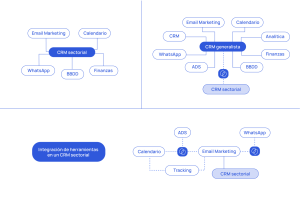
At Driza, based on our experience and defending what is our responsibility, we have always avoided recommending the option of depending 100% solely on sector-specific CRMs. Since to add digital marketing and nurturing options, you have to depend on contracting extra integrations that will cost you more money and almost 100% certainly will not integrate adequate analytics and traceability.
If you have the team and the investment, we encourage you to choose to have a generalist CRM for marketing actions and keep the patient history in a sector-specific CRM. This option is the most expensive option, but the one that will provide you with the best data and will be the most scalable.
If you do not have the team and the investment, we encourage you to choose an appointment booking tool that provides you with a calendar, analytical integration, and integration with other marketing automation tools and use legal data management from your niche CRM.
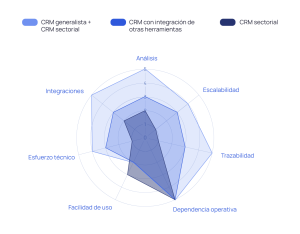
We, as experts in digital marketing consulting, will tell you that you will never be able to know what happens if you do not invest in other extra tools that help you generate the data you need.