Taking your business international sounds like growth, opportunities, and new markets… but when the target country is China, you need to completely change your mindset.
And no, it is not just because the language and culture are different. We are talking about a digital ecosystem that is completely different from what you are used to. Google does not exist, social networks are different, the rules of the game change, and Baidu has its own rules, algorithms, and technical requirements.
Before you get into this, you should know it is no small feat. Why? I explain it below.
What does the Great Firewall mean in practice for indexing speed and SEO?
If you are thinking about ranking your website on Baidu, one of the first obstacles you will encounter is the Great Firewall of China. This is an internet censorship and filtering system that not only blocks content the Chinese government considers inappropriate, but also has a significant impact on the performance and accessibility of websites outside China.
What does this mean for SEO and the indexing of your website on Baidu?
- Load speed: The GFW can slow access to your page, affecting load speed. Baidu, like Google, values how quickly a page loads. However, due to the GFW, servers outside China experience additional latency, which can negatively affect the user experience and, therefore, rankings on Baidu.
- Access and crawling: The GFW also affects the ability of search engines, such as Baidu, to crawl and index your website efficiently. In addition, multimedia content and certain scripts that rely on external services, such as Google Analytics or YouTube, may not work properly and make your page appear “broken”, as these are also blocked in China.
Indexing speed: In a normal environment, a search engine indexes new content quickly, but with the GFW, this process can slow down considerably.
How can you solve this problem?
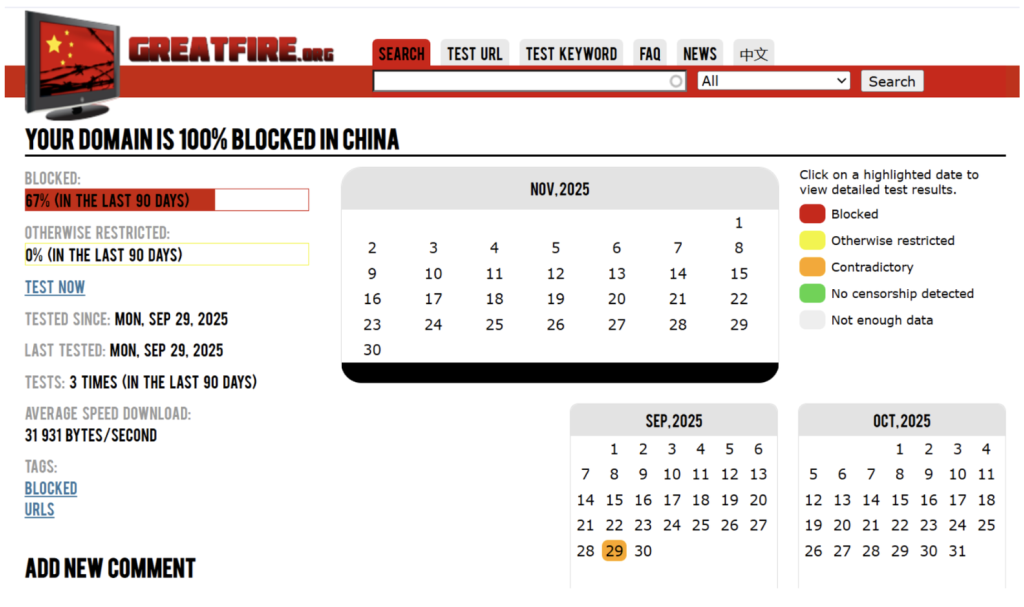
My first recommendation is to check whether your website is blocked via en.greatfire.org/analyzer (an organization that fights Chinese government censorship). If it is, you should:
- Keep your Chinese website separate. No subdirectories, subdomains, or .cn.
- Use web hosting in China or nearby. You will face quite a bit of bureaucracy here—the further you can get in the process, the better. In other words, a CDN is fine, but hosting in mainland China will add far more value.
- Use local tools and drop those banned by the government: Google, Bing, Meta…
All of this will help you get past this firewall, but the path to ranking on Baidu does not end here… keep reading.
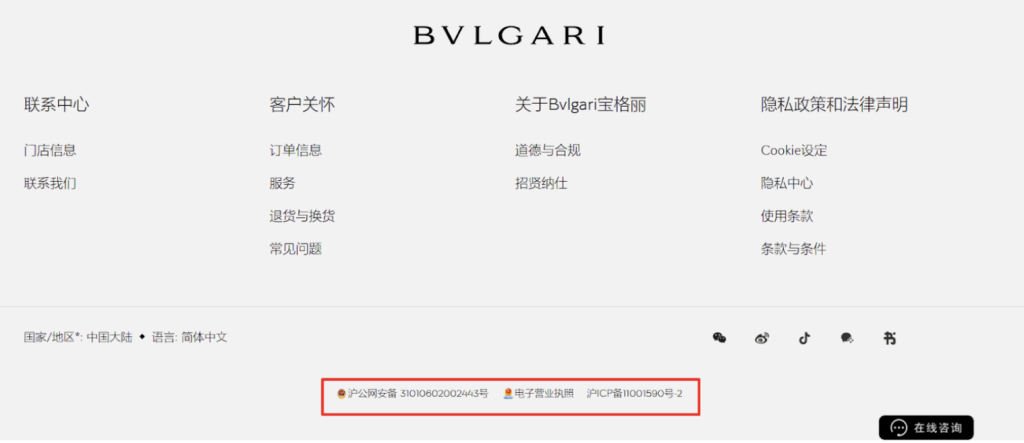
The ICP license (Internet Content Provider License) is a permit granted by the Chinese government for a website to operate legally within its territory. And here is the key point: to host your website on servers within China, this license is mandatory, without exception.
There are two types: ICP Bei’an license (basic, for informational websites) and Commercial ICP license (advanced, for e-commerce). The first is somewhat easier to obtain; the second requires meeting a series of complex requirements (the Chinese government holding part ownership, being a joint venture, having a Chinese business license…). Above all, you will need a partner. Alibaba offers this service for around €5,000 (to give you an idea of potential unexpected costs).
Is an ICP license really necessary to sell in this country?
Legally, yes; in practice, not necessarily. You can check whether your competitors ranking here have this license—usually it is shown in the footer (example: Bulgari’s cn website). So draw your own conclusions.
Likewise, if organic is going to be key within your strategy, consider this point carefully because, as you already know, it is an essential requirement to host your website in China—and that works in your favor. On top of that, you will be able to use a .cn, which is a plus not only for rankings but also for credibility.
If China is a target market, the recommendation is to run the numbers and see whether it is worth it.
Any alternative to the ICP license for an e-commerce business?
If you decide to sell in China without an ICP license anyway, before they shut you down, one option would be to use third-party platforms such as Tmall or JD (not the clothing store), which are already registered in the country and have ICP licenses and customers. These platforms allow international businesses to sell their products in China without having to register their own website with an ICP license. However, control over your brand will be limited, and you will lose autonomy over your online presence.
How does optimization logic change on Baidu vs. Google (weight of metadata, local backlinks, UX)?
Moving into rankings: when we talk about search engine optimization, Baidu and Google are two very different worlds. Although both search engines have a similar goal (providing relevant results to users), their algorithms and priorities are notably different. A few points to keep in mind:
1. The weight of metadata
In Baidu’s case, metadata still plays a very important role, especially the title tag and meta description. While Google has been reducing the importance of meta keywords and has started to value semantic content more, Baidu still considers metadata significantly. You can still skip meta keywords, though.
2. Local vs. international backlinks
This is where the differences are most noticeable. While Google values backlinks globally, Baidu places great importance on local backlinks, especially those coming from websites hosted within China. Link relevance is assessed based on geographic proximity and authority within the Chinese ecosystem.
It is essential to secure local backlinks from Chinese websites. In this regard, working with local platforms and portals such as WeChat, Baidu Baike (the Chinese Wikipedia), or Chinese forums and blogs can be an effective strategy to improve your ranking on Baidu. Even getting mentions on sites such as QQ and Sina Weibo can be beneficial.
3. User experience (UX)
User experience on Baidu is closely tied to website load speed, a clear structure, and mobile compatibility. Although Baidu values user experience, its approach is not as demanding as Google’s in terms of interactivity or visual design. However, load times are a priority for Baidu, especially because of the impact the Great Firewall has on speed.
4. Language and culturally relevant content
On Baidu, content must be fully adapted to the local language and culture. Do not just translate your content—localize it. Make sure you use cultural and behavioral references that resonate with a Chinese audience.
Which search engines and web portals are most popular?
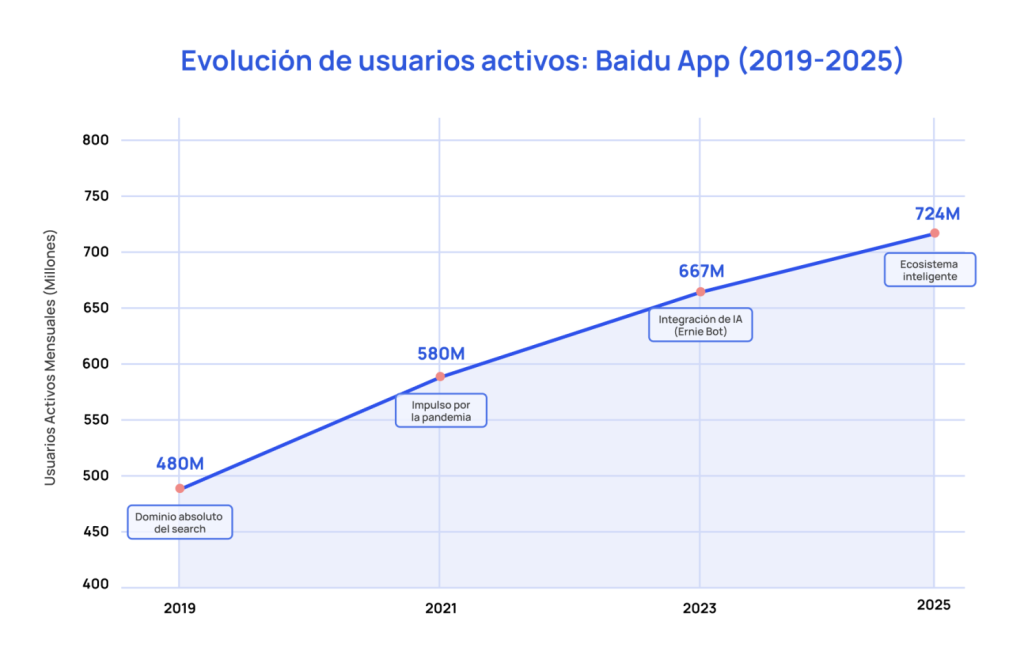
As you might expect, the most used search engine is Baidu, with over 70% of the market, making it the primary target for any company that wants to rank its website in China. Like Google in the West, Baidu is the gateway to Chinese users.
Besides Baidu, Sogou is another relevant search engine, especially in visual and multimedia content niches. Although it has a smaller market share, around 15–20%, it is important to consider it within your strategy, as some users prefer it for its integration with Sohu, a popular news portal in China.
There are web portals that play a fundamental role in the Chinese ecosystem. WeChat and QQ, although they are messaging apps, also function as integrated content and search platforms. We could compare them to WhatsApp or Telegram in Spain, but with a much broader focus that includes news, online shopping, and financial services.
(This sums up much of the Chinese situation, but, as you can see, it is far more extensive than in Europe, where our biggest concern—aside from Google—is LLMs.)
Is it viable to compete in SEO from outside China without local infrastructure?
Short answer: yes, but it will not be cheap. As you have seen, competing in SEO in China involves a series of requirements that are difficult to meet, just to have a chance of ranking. On top of that, you need to add: new rules of the game (Baidu and Google are not the same, my friend), the complexity of the Chinese market (and the many players involved), the language (in French, Portuguese, German? you can more or less get by, but in Simplified Chinese…) and usability (payment methods, contact channels, currency… everything has to be adapted).
With all this in mind, the most advisable approach is to work with a local partner who can, at the very least, help you set up the basic infrastructure to build on. Otherwise, be aware of the mess you are getting into.
The main conclusion, from a marketing and financial perspective, is that entering China’s digital market through Baidu and SEO represents a high-potential strategic investment, but with a significantly high barrier to entry that requires rigorous planning and a substantial capital commitment. The Chinese ecosystem, shaped by the Great Firewall and the need for ICP licenses, nullifies the effectiveness of Western plug-and-play SEO strategies. Financially, this translates into mandatory local infrastructure costs (servers, licenses) and the need for investment in talent or local partners for content adaptation and technical management. Trying to operate from outside without these requirements is a false economy that will result in a low or zero return on investment (ROI) due to low visibility and slow load times.
From a marketing standpoint, adaptation is not optional. The heavy prioritization of local backlinks, the critical importance of load speed for UX, and the need for full cultural localization of content require designing a digital marketing strategy with China as its operational center. The alternative of using platforms such as Tmall or JD reduces technical and legal (ICP) complexity in the short term, but entails a loss of control over the brand and customer data, which in the long term limits the building of proprietary digital assets. Therefore, the critical financial decision is to weigh the upfront cost of establishing your own infrastructure against the growth limitations and per-transaction costs imposed by third-party marketplaces.
Conclusion before you dive into the Baidu pool
As you have seen, the viability of the SEO/Baidu strategy is intrinsically linked to the company’s willingness and ability to make the initial investment required to localize infrastructure (both physical/digital and human).
It is an “all or nothing” decision: either you commit to investing in the resources to overcome the GFW, obtain the ICP license, and develop the roadmap from start to finish, or, inevitably, you will be opting for a strategy with a low probability of success and no clear return on investment. It is difficult to set milestones when you do not know which obstacles will prevent you from moving forward.
In short, if the Chinese market is not valuable enough to justify the increase in CPA, you do not have the technological infrastructure to build a separate environment, or you are not willing to rely on local partners, it is better to stay out of the water.
Sources: