For some, building a business through the organic channel is an unknown. Crawling, indexing, semantics, Core Web Vitals, structured data… many technical terms that are difficult to understand and far removed from ROAS.
For this reason, I will explain how an SEO proyecto works, setting aside the technical aspects and focusing on what matters: return on investment and why investing in SEO is investing in CAPEX.
All stages of an SEO proyecto
An SEO proyecto involves several stages that should be understood so that 1) it doesn’t overwhelm you and 2) you don’t get scared prematurely. The main ones you should keep in mind are the following:
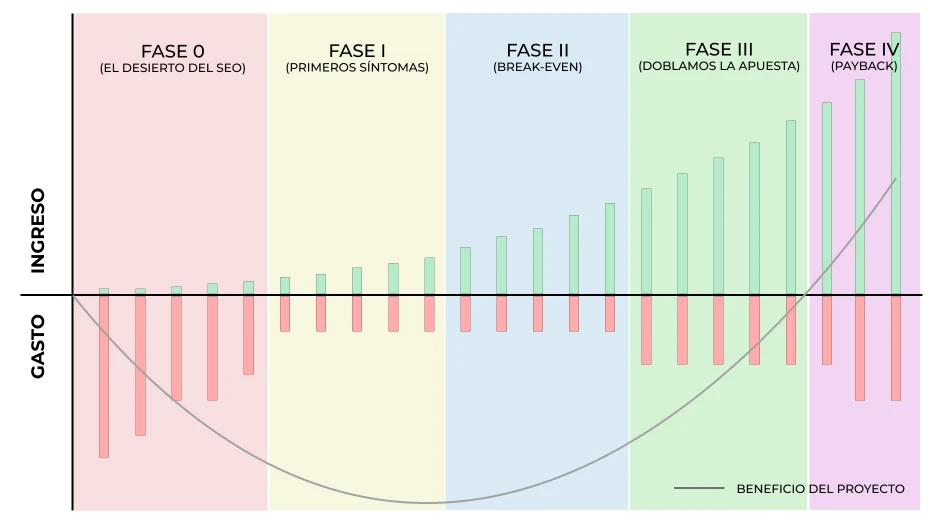
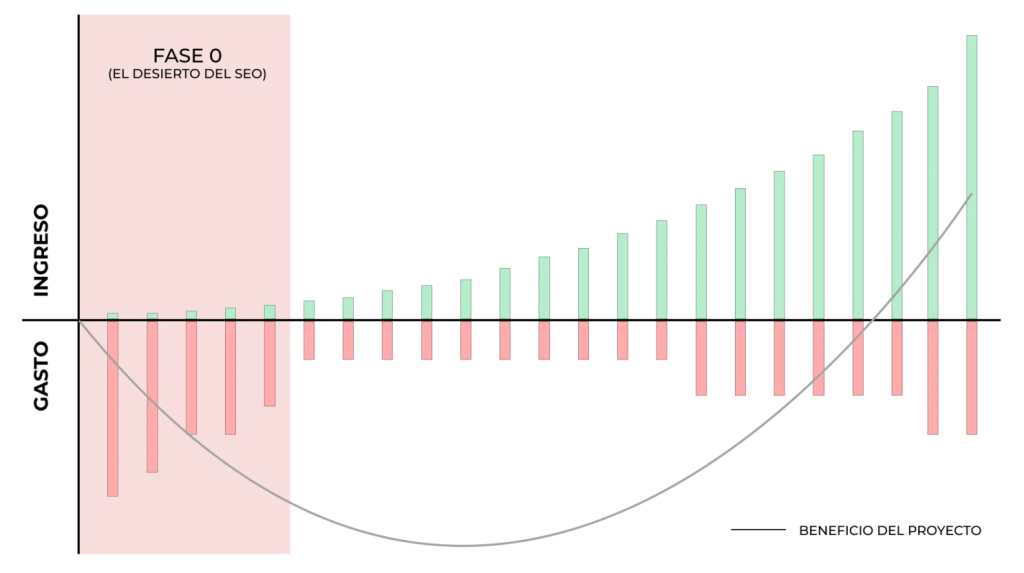
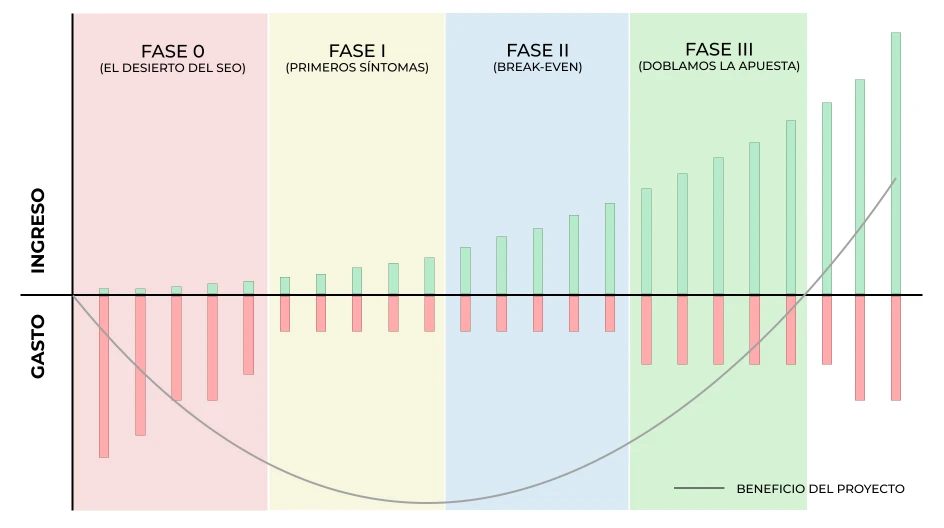
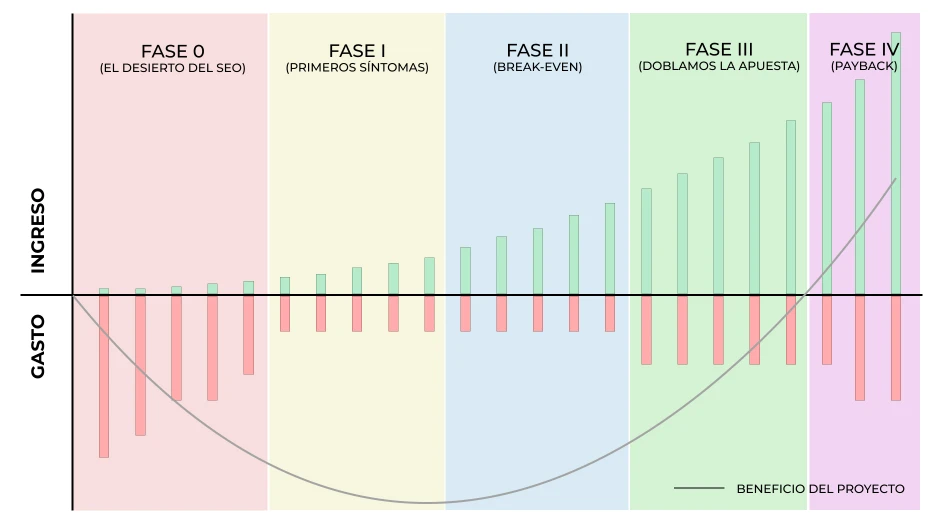
PHASE 0 – The SEO Desert: This involves disbursing the initial investment, which is the largest part of the proyecto in the short term.
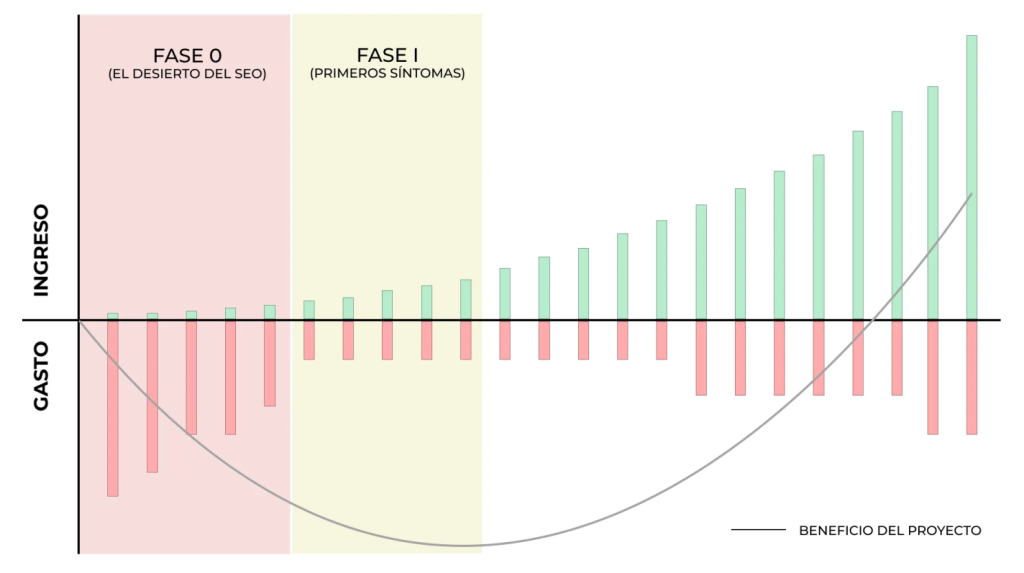
PHASE 1 – First Symptoms: The first green shoots begin to appear: visibility, sessions, the revenue lever starts to movo…
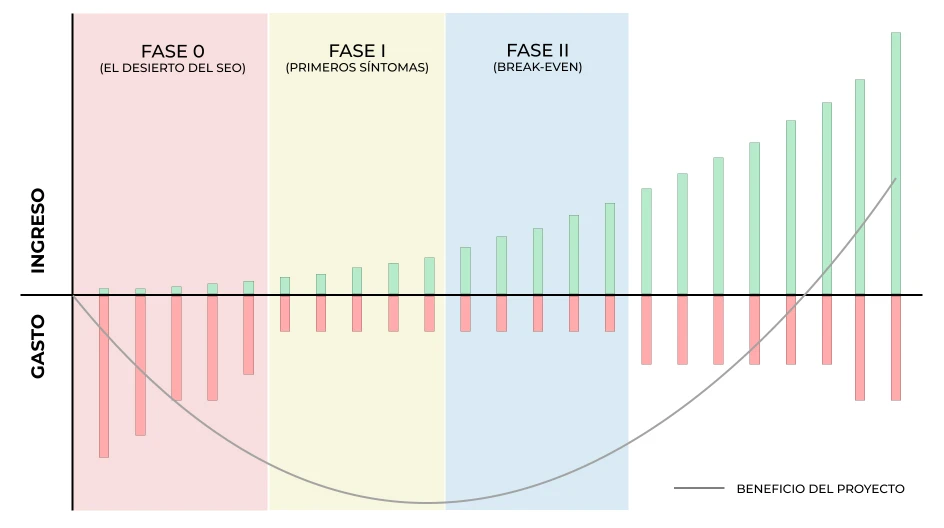
PHASE 2 – Break-even: In recurring revenue, income already exceeds expenses.
PHASE 3 – Doubling Down: To maintain the scaling pace, increased efforts are required.
PHASE 4 – Payback: After several months and years, the investment in the proyecto is recovered, and the organic channel transforms from a liability into an asset for the company.
All stages of an SEO proyecto
PHASE 0 – The SEO Desert
This is undoubtedly the most challenging stage. You are determined to diversify revenue streams and open up to the organic channel, but you receive the bad news: for us to begin, we will need an investment of several thousand euros during the first 3 months (this can range from €2,000 to €15,000).
If you already had doubts… traversing this desert of expenses without glimpsing benefits becomes a torment for some companies where cash flow is tight.
Phase 0: The SEO Desert
Why such a high figure at the beginning of the proyecto?
Primarily, this initial outlay is necessary to prepare the groundwork before we get to work on the strategy. In this way:
We investigate what and how people search, and to what extent
We organize the website to create pages that can answer those searches (and we create them, with the effort that entails depending on the type of business)
We audit the website and check: HTML tags (how do Google and its relatives read the website?), structured data, web speed, internal and external linking… And we implement the relevant changes.
In some cases, in addition to all the above, investment in external media will also be necessary to foster domain authority, but we will leave this for another time.
Is it possible to reduce or spread it out?
Here, it will depend on the client and how much effort can be delegated to them:
Do they have the capacity to write content?
Do they have a development team to carry out technical implementations?
Do they have prior experience working with SEO or are they starting from scratch?
The more availability they have to participate in the process, the less investment will be needed in this initial stage.
It’s not that the cost disappears (salaries are paid regardless), but it does help to cover a workload that might otherwise be excessive. It’s not the same as taking 10 hours a month from the in-house developer as paying an external party on a recurring basis.
Likewise, there will be scenarios where it is possible to dose it and stretch it a bit further so it doesn’t hit the cash flow as hard. Here, expectations would need to be analyzed and an assessment made of how far we can stretch this and what other financial efforts are required. At this point, it is very common to use paid channels to finance at least this initial SEO stage and gain a bit more breathing room in working capital.
PHASE I – First Symptoms
After several months of obscurity, results begin to appear. The revenue compass barely movos, but you start to see: more impressions, more visits, more WhatsApp inquiries and contacts…
These are the first symptoms that the SEO strategy, despite being several months away from yielding benefits, makes sense and is on its way to becoming an asset.
Phase 1: First Symptoms
When does this new stage begin?
We primarily enter this stage when, after the first few months (usually between 3 and 6), we start to see that the curve of some KPIs begins to gain traction. Normally, the order of traction is as follows:
First, impressions increase, and it’s especially important to ensure this is for relevant terms. This implies that we are starting to be considered for answering certain searches of interest.
Subsequently, sessions increase. As a result of gaining visibility, the first visits begin to arrive. This will make the wheel start to turn: ↑ CTR = ↑ Positions.
Finally, it begins to show in contacts/leads/sales. Although it may not offset the investment made so far, there will start to be more “noise” in the business: more inquiries via WhatsApp, some leads captured, more sales with lower ticket values…
⚠️ If months pass and no signs of the above are seen, alarm bells should ring, and it should be checked what is not working.
Phase II – Break-even
After seeing green shoots, a point is reached where the monthly ROAS begins to be positive. The recurring burden is no longer as heavy because more is harvested than sown on a daily basis; we start to earn more than we spend on a monthly recurring basis.
It is important to reach this point because it reduces financial stress on cash flow, and also mental stress, let’s be honest.
(At this point, trust, if it was ever questioned, gains strength and allows for better collaboration between both parties).
Phase 2: Break-even
How long does it take to reach this point?
This is a common question because, despite impressions, visits, leads… this does not always end up generating business. The important thing at this point is, as seen in the graph, thatorganic revenue, however slow, never stops increasing (seasonality aside).
It should especially concern us if, despite the work done, revenue remains flat or even declines.
If you want a short answer, it usually takes about 1 year into the proyecto to reach this point.
What are the implications of this stage?
If we have already reached this point, the main implication of this stage is answering the question: “What levers are we going to activate to continue growing?”.
Despite being a comfortable moment, it is the ideal time to consider what the next steps will be to take revenue to the next level and what resources will be necessary.
Phase III – Doubling Down
Having reached this point, if we want the organic revenue curve to continue steepening, it will be advisable to increase investment. This increase in investment does not sting because a ROAS will have already been achieved that allows for investment with peace of mind, but it is important to be aware that this moment will arrive sooner or later.
At this point, those barriers that were set aside due to lack of technological resources, time, or money must be addressed. The timings for these can be negotiated; however, if you want to move to the next level in revenue, it is a door that must be crossed sooner or later.
Phase 3: Doubling Down
What kind of investments will be necessary at this point?
Mainly, they will be distinguished into 2 branches: physical/digital resources or human resources (time/knowledge):
Physical/Digital Resources
This includes resources that, due to their significant necessary involvement, were set aside. Some of the most common are:
Improvement of server storage and performance
Translation, adaptation, and/or linguistic review of the website (if it was automatically translated)
Major modifications to the website’s code
Implementations that allow improving page quality (such as a review system, additional content…)
Acquisition of backlinks and mentions in paid media to support the digital PR and domain authority strategy
Human Resources
Regarding human effort, it will be necessary to assess whether the required effort is the same or greater than at the beginning of the proyecto and, if greater, in which areas more hours need to be invested. The most common are:
More hours of consulting (more data volume requires more time for analysis)
More hours or expertise in technical implementation (technical implementations are becoming increasingly complex and demanding)
More hours of writing (for product/category/service descriptions as well as blog posts).
Phase IV – Payback
Finally, we reach the payback point, where we will have recovered all the investment made in the proyecto.
Phase 4: Payback
This stage is the most important of the proyecto, and the one that should be sought from the beginning, because it is the moment when SEO ceases to be a LIABILITY to become an ASSET for the company, and it becomes tangible that investing in SEO is not investing in OPEX but in CAPEX.
What happens after break-even?
That said, reaching the break-even point is not the final goal, but rather the starting gun for a new reality for your company. At this stage, the customer acquisition cost (CAC) through the organic channel plummets, allowing for profit margins that other channels (such as paid traffic) can hardly sustain in the long term due to bid inflation.
At this point, it’s time to sit down, re-evaluate efforts, estimates, and objectives, and re-tune the marketing orchestra to see how we can 1) maximize the incoming traffic (this is where CRO and visit quality come into play) and 2) continue to expand the customer funnel that lands in our ecosystem.
SEO for Finance Professionals
Category
Add your header text here
Company size
Add your header text here
Sector
Add your header text here
Proyecto
Lorem ipsum dolor sit amet, consectetur adipiscing elit. Ut elit tellus, luctus nec ullamcorper mattis, pulvinar dapibus leo.