“Fresh is not the same as new”
We have all done it at some point. We change a date in the title, add two paragraphs, and update the last modified tag in the hope that Google will think the content is new.
But… does Google really distinguish between truly new content and content where we have simply changed the date?
Short answer: it is not so easily fooled. The long answer: it depends more on what you change than when you change it.
What “freshness” means to Google (and what it doesn’t)
Freshness is not a fixed metric, but a contextual signal that Google applies based on search intent. The Query Deserves Freshness (QDF) algorithm is activated when it detects that users expect recent results—for example, in searches regarding technology, news, or products/services where up-to-date information is expected.
According to the Google patent “Freshness-based ranking” (US8832088B1), the system adjusts rankings to give more visibility to results it considers more up-to-date; that is, those offering information that best responds to the search intent at that moment.
Google does not reward the new for being new, but rather when timeliness is what the user actually needs.
In practical terms: if the novelty adds real value to the query, the content ranks better. Therefore, Google also distinguishes between superficial updates (such as only changing the date) and substantial updates (adding data, restructuring content, or modifying the approach to make it more useful).
How does Google detect it?
Google does not only look at the update date, but also at how the content changes. The algorithm looks for signals that it has actually been modified to improve the relevance and usefulness of the article.
- Superficial update: If only the date is changed or a couple of sentences are added without significant contribution, the algorithm detects that the change does not improve the value of the content. In this case, the algorithm does not consider the content as new.
- Substantial update: If sections are reorganized, updated data is added, or the semantic focus is changed to make it more useful and relevant to the user’s intent, Google considers it a real change. These types of changes can lead to the content being treated as new in that context.
By the way: including the “dateModified” attribute in your code (within the article schema) helps Google understand when the content was updated, but it is not a direct ranking signal. It only has an effect if the change is real: if Google detects that the date and the content do not match, it ignores the update or may even interpret it as manipulation.
The myth of “fresh content”
When Google launched the Freshness Update, half the SEO world understood it as the more recent, the better. And that is where the madness began: headlines with crossed-out years, “updated in 2025” in every post, and articles that age in a loop.
But as we have said, Google is not easily fooled.
It perfectly distinguishes between superficial changes (updating the date, moving paragraphs, adding two sentences) and real changes (new structure, more data, complete sections, or a different approach).
In summary: what Google values is not chronology, but relevance.
It does not reward the latest for being the latest: it rewards what remains useful now.
How media and newspapers manage this
In the case of media outlets, Google treats updates differently. News articles are subject to the QDF (Query Deserves Freshness) algorithm and the Top Stories system.
Each update can temporarily renew the article’s visibility if it provides new information, statements, or context.
But beware: Google distinguishes between “update” and “rewrite”.
- If a media outlet republishes an old news story with the same URL and without substantial changes, visibility drops quickly.
- In contrast, developing coverage (for example, elections, disasters, launches) can benefit from frequent updates because the search intent does demand immediacy.
The danger of “fake freshness”
Updating the meta title with “2025” may give you a small CTR boost, but it will not be sustained. Google evaluates user behavior: if the CTR rises only because of the date, but the user bounces, the signal is corrected.
The interesting thing is that many evergreen pieces do not lose traffic because they are old, but because others update them better. Not more recently, but more relevantly.
Modern SEO does not reward novelty: it rewards validity.
Being up-to-date can open the door to the click, but only value keeps that door open. The correlation between “updated content” and CTR is not direct: the user—not the date—decides if the content remains relevant.
How to measure if the update actually improves your CTR
You can measure the impact of an update in Google Search Console by comparing the CTR and average position before and after updating. If the CTR rises without the position falling or the bounce rate increasing, it means the update has provided real value and not just a superficial change.
Google also evaluates how users interact with the content after the update. If the CTR improves and users stay on the page, the content is relevant. But if the CTR rises only because of the date, yet the user bounces because the content does not meet expectations, the impact will be temporary and will be corrected over time.
When to update (and when not to touch anything)
Update when:
- Data, prices, laws, or tools change.
- Search intent evolves (“best CRM 2021” → “best AI CRM 2024”).
- Your user signals drop (CTR, time on page, bounce rate).
- Your competitors publish more complete or recent versions.
Do not touch when:
- The article is still ranking well and has good backlinks.
- You are only going to change the date without providing real value.
- The query does not require novelty (e.g., “how to plant a bonsai”).
💡 Pro tip: keep the same URL and document the changes.
Sectors where being up-to-date matters (and where it doesn’t)
- News and technology: decisive. Every hour matters.
- Finance, law, HR: high contextual relevance.
- Healthcare: advances and updates in treatments, laws, and regulations are key.
- eCommerce: medium; influences seasonal collections and stock.
- Branding, design, training: low; authority and depth carry more weight.
In general, Google prefers stability in search results: content with years of history, good links, and behavioral consistency.
In the Ahrefs study on ranking longevity, 72.9% of pages in the top 10 are more than three years old. Age, far from penalizing, reinforces trust.
And how does this affect AIs?
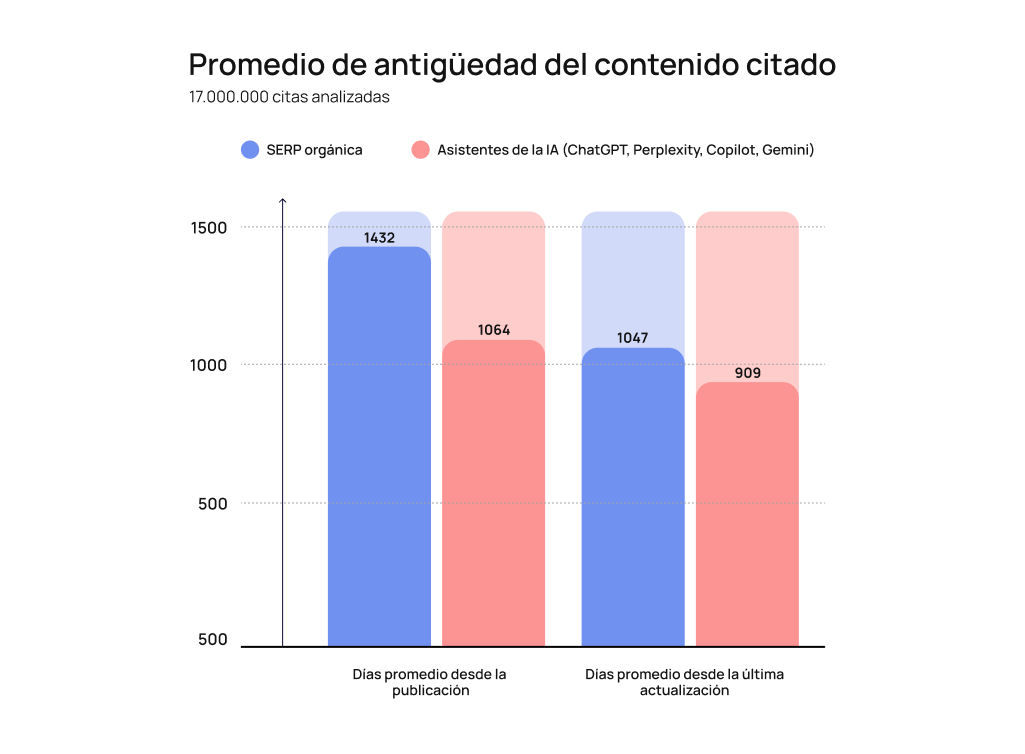
While Google prefers stability and values the age of content, AIs tend to prioritize more up-to-date information. AI assistants like ChatGPT, Perplexity, or Copilot look for recent content to offer more relevant answers aligned with the user’s search intent.
According to an Ahrefs study, AI assistants cite more recent content compared to traditional SERP results. This reflects the growing importance of keeping content updated if you wish to be visible not only in organic searches but also in AI-generated responses.
The same applies to apps
In Google Play Console, updating frequently does not guarantee more visibility. What really drives your ranking is the quality of the versions you release.
If each update fixes bugs or provides real improvements, Google interprets it as a signal of active maintenance. But if you only publish minor revisions without substantive changes, the system stops valuing it with the same strength.
In SEO, it is the same: it does not matter how many times you “update” your content, but how much better it is after doing so.
In summary, SEO is obsessed with the new, but Google does not reward novelty; it rewards validity. So before changing the date of your next post, ask yourself:
Are you baking fresh bread… or just reheating yesterday’s?