Imagine the following scenario: you are an SEO Manager and, after months of hard work optimizing a website, you achieve impressive results. We’re talking about a 70% increase in organic traffic and a 50% rise in conversions. Filled with pride, you present these data to your director, expecting an ovation, but instead, you receive a devastating question: “How do you know this happened exactly because of what you did?”.
That is the harsh reality of our industry. SEO has an undeserved reputation for being difficult to track and is traditionally perceived as the least measurable marketing channel compared to email, PPC, or social media. In fact, almost a third of professionals state that demonstrating the value of their work to stakeholders is their biggest challenge.
Without structured testing, a traffic increase could be due to seasonality, a Google algorithm update, or a competitor losing visibility. Guessing is no longer a viable option when budgets are at stake. That’s why today at Cónclave, we’re going to delve into how SEO A/B Testing allows you to stop talking about abstract metrics and start talking about real business impact.
What exactly is SEO A/B testing? (and why it’s not the same as CRO)
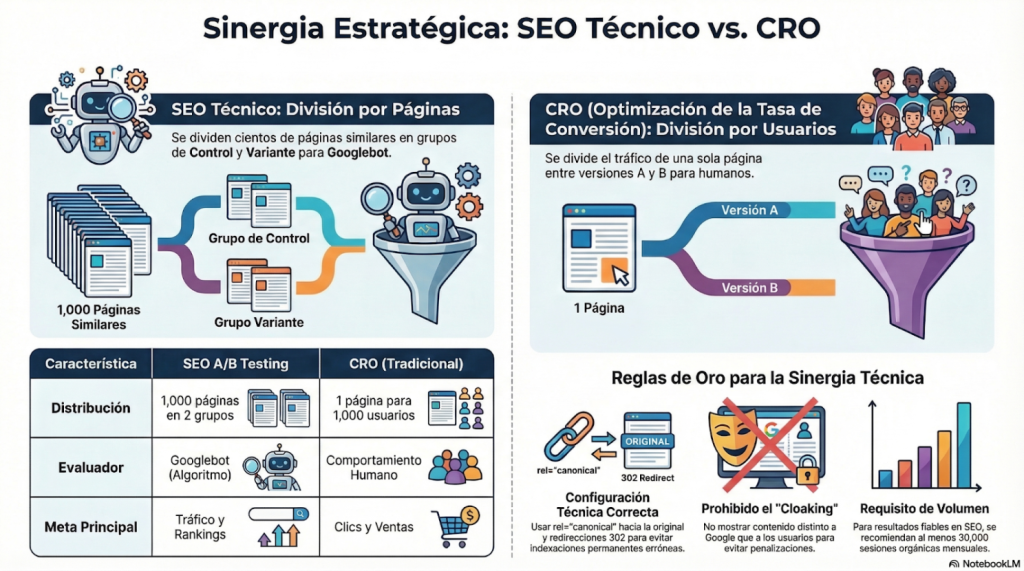
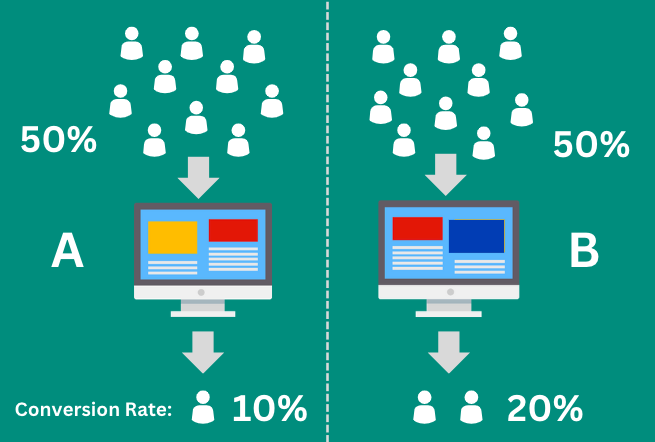
Conversion Rate Optimization (CRO) and user experience have been using A/B tests for years. In traditional CRO, the process is simple: you create several versions of a page (e.g., changing a button’s color or design) and randomly split your audience (users) to show them one version or another. Then, you compare which version generated more clicks or sales.
But SEO doesn’t work that way. In our discipline, the primary “user” we want to convince in the first instance is Googlebot, GPTbot, and similar bots.
We cannot simply show two different versions of the same URL to Google for indexing. Doing so directly violates search engine guidelines, as it is defined as cloaking. So, how do we apply the scientific method to organic ranking?
The answer is that in SEO, we don’t split users; we split pages.
Instead of showing variations to different people, we take a set of pages that share the same template and intent (e.g., product pages of an e-commerce site) and divide them into two groups: a control group (which remains exactly the same) and a variant group (to which we apply the SEO optimization). Then, we analyze these modified pages in terms of crawling, indexing, and organic traffic.
The Danger of Poorly Controlled Experiments
To understand the importance of a real A/B test, we must identify what is not a valid test. Often, in the SEO industry, we rely on “anecdotal evidence” or poorly controlled tests. Some examples of what you should avoid are:
- Before-and-after studies (Pre-post studies): This involves changing a group of pages without any randomization or control group and comparing traffic before and after. The problem here is that external factors, such as search demand or Google updates, can alter the results.
- Single-case experiments: Changing an H1 tag or a title on a single page and tracking traffic.
- Observational studies: Trying to find correlations by analyzing, for example, common factors among the top 10 Google positions at a given time. This shows correlation, but never causation.
To determine true causal relationships, randomized controlled experiments are the gold standard.
Is my website ready for an SEO test?
Before getting into this mess, you should know that not all websites are suitable for experimentation. If you have a small blog or a corporate website with low traffic, external factors and market fluctuations will ruin your data.
For a test to be statistically reliable and valid, your site should meet two main requirements:
- Page volume: You need at least 300 template-based pages. For example: e-commerce listings, travel destinations, real estate pages, or job portals.
- Traffic volume: A minimum of 30,000 organic sessions per month is recommended for each experiment. The higher and more stable your traffic, the easier it will be to build a robust predictive model.
What type of businesses should then invest in A/B testing?
Ideal candidates for implementing SEO A/B testing are sites with extensive catalogs:
- E-commerce sites: Product pages, online store categories.
- Travel and booking portals: Destinations, hotels, flights.
- Classifieds and Marketplaces: Real estate portals, job websites, second-hand sales.
- Large media outlets or newspapers: Sites with thousands of articles with similar structures.
What about Startups?
Given the need for a stable traffic history and large session volumes for the predictive model to work, early-stage startups are usually not good candidates. They lack the necessary volume, and any traffic spike would distort the data. This service is aimed at established companies or “Scale-ups” looking to optimize their market share or protect their current traffic against risky changes.
What if my website has low traffic volume?
If you don’t reach those numbers, it’s still possible to conduct tests, but you will face three major challenges:
- Less reliable results: It will be much harder to isolate the success of the test from external factors (seasonality, trends).
- You need a drastic impact: On small websites, the change you apply must generate a gigantic increase in traffic for the mathematical model to detect it as valid “statistical significance.” Small improvements of 5% will go unnoticed as statistical noise.
- Longer waiting time: You will have to let the test run for much longer (weeks or months) and limit the frequency of your tests to accumulate enough data.
How to Design and Execute the Perfect SEO Test (Step by Step)
If your proyecto meets the requirements, the methodology for executing an experiment without failing in the attempt is divided into the following phases:
1. Define your hypothesis and choose what to test
Every test must originate from a clear hypothesis. It’s not about changing for the sake of changing. You can start with on-page beginner-level optimizations, such as adding the word “free” to a meta description, removing the brand name from the title tag, or modifying an image’s alt text.
Although they may seem like minuscule changes, the impact can be massive. For example, several e-commerce sites decided to conduct a test by removing the last part of their breadcrumbs and experienced an increase of around 10% in organic traffic in just 21 days. In another case documented in an SEO talk, adding at least 15 internal links to 30 selected pages generated a +6% conversion after 40 days.
2. The Art of Splitting Pages (Bucketing)
This is where the vast majority of SEOs fail. Deciding which pages go into the control group and which into the variant cannot be done randomly without criteria. Both groups must have a similar historical traffic behavior and react similarly to seasonality.
Imagine a pet e-commerce site. If you make the mistake of putting all “cat” products in the variant group and “dog” products in the control, you expose yourself to an analytical disaster. If the test coincides with International Cat Day, your variant group’s traffic will skyrocket. This will lead you to mistakenly believe your SEO change was a resounding success when it was actually a false positive caused by a specific date. To avoid this bias, you must perform smart bucketing: distribute page types equally (for example, half of cat products to the control and half to the variant).
3. Implementation: Server-side or Client-side?
When applying the code for the test, you have two options:
- Server-side: The element you are changing is fundamentally integrated into the page itself. This is the recommended option because it guarantees that Googlebot sees the change immediately, but it requires relying on the development and engineering team. It’s important to remember that Google usually waits only about five seconds to render content, so anything that loads afterward might not be evaluated.
- Client-side: Uses JavaScript. It is much easier and faster for an SEO team to install without external help, but it can generate a slight visual flicker for the user, and there is a risk that the search engine may not process the modification correctly.
4. Isolation and Duration of the Experiment
To avoid contaminating the data, it is vital to isolate the test as much as possible. This means you should not touch the control group under any circumstances during the test period (neither add links, nor modify content, nor launch cross-campaigns). Additionally, you must establish a clear start date.
The pre-analysis data period (pre-period) should be twice as long as the test period (for example, if you measure in December, use October and November as the historical baseline). As a general rule, an SEO experiment needs between 2 and 4 weeks to reach statistical significance. However, avoid conducting tests during periods of high volatility, such as Christmas or Black Friday, unless you are specifically testing seasonal elements.
5. Measure the Real Impact (Forget Traditional Rank Tracking)
A very common question is why we don’t simply use Search Console’s CTR or rank tracking to measure success. The reality is that rank tracking tools cannot efficiently cover the long tail of keywords, and CTR data in Search Console is often inaccurate, scarce, or averaged.
To obtain enterprise-level results, mathematical models such as Causal Impact or neural networks should be used. The process works as follows:
- Approximately 100 days of historical data are collected for the control and variant groups.
- A forecast model is built that predicts what future traffic should be if no changes were made.
- The test is launched, and the actual traffic of the variant group is compared against the forecast and against the behavior of the control group. If the actual traffic significantly exceeds the forecast, pointing to a statistical significance of 90-95%, you have a winning test.
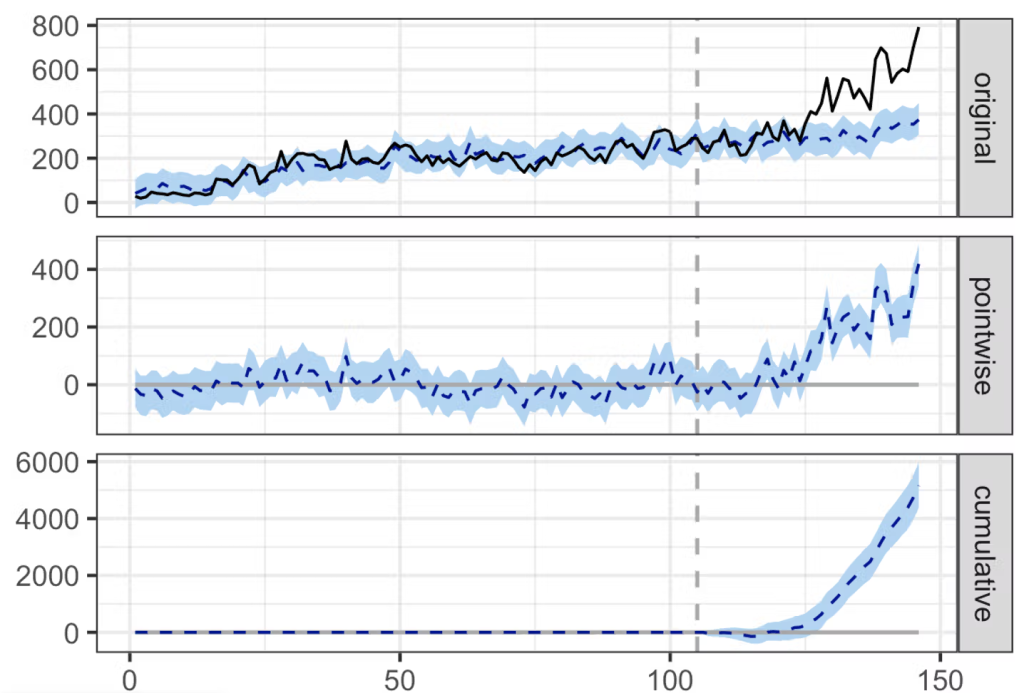
The foreground shows the actual data (solid line) vs. the prediction of what would have happened without the change (horizontal dotted line). The vertical line marks the intervention date. The blue area is the model’s margin of error.
The Rules of the Game According to Google
Google does not oppose experimentation. On the contrary, it allows it and provides official documentation on the matter. However, if you are going to play on its turf, you must follow its regulations strictly to avoid penalties:
- Zero cloaking: Do not show one URL to the Googlebot and a different one to users using cookies. Any massive alteration that differs drastically in content and scope could be interpreted as fraud.
- Use 302, not 301 redirects: If your test involves redirecting users from an original URL to a variant, use temporary redirects (302). Using 301 (permanent) redirects will indicate to Google that the page has moved forever, which does not apply to a temporary test.
- Use rel = “canonical”: If you are forced to create multiple test URLs, group them by adding the rel=”canonical” tag pointing to the preferred original URL. Using noindex tags in this context can lead to unforeseen negative results.
- Don’t drag it out: A test should last only as long as strictly necessary to collect conclusive data. Prolonging an experiment unnecessarily, especially if it affects a large portion of your users, can be perceived by Google as an attempt to manipulate search results.
Tools for Putting A/B Testing into Practice
Depending on your company’s financial muscle and technical knowledge, the current ecosystem offers various solutions:
- SearchPilot: Server-side platform. Stands out for its use of neural networks and Full-Funnel tests (combining SEO and CRO simultaneously). Ideal for large enterprises and very high-traffic websites.
- SplitSignal: Uses client-side JavaScript and Google’s CausalImpact model. Ideal for SEO teams that need speed and autonomy without relying on developers.
- SEOTesting: Conducts time-based (Pre/Post) tests using Google Search Console data. Ideal for medium-sized sites looking for a functional and more affordable option.
- Optimizely / Unbounce: WYSIWYG tools focused on landing pages and tests geared more towards CRO than pure SEO. Ideal for marketing teams focused purely on paid conversions or specific campaigns.
- RStudio + Causal Impact: Data science approach. Use custom scripts or generate Python code via ChatGPT and Google Colab. Also complemented by free tools like Koen Leemans’ for URL splitting. Ideal for data scientists and technical SEOs with tight budgets.
The Diagnosis Problem: Why Did My Test Work?
Imagine you launch an A/B test and change three things at once on the variant group pages: you modify the title tag, improve image loading speed, and change the URL directory structure. After a month, the variant group’s traffic skyrockets. Total success!
But here comes the diagnosis problem: Was it the title, the images, or the directory that caused the improvement? You have no idea.
The golden rule: In a traditional A/B test, only one element per page should be tested at a time to isolate the cause of success or failure.
What if I want to test several things?
If you want to test several changes to see how they interact with each other, you must resort to multivariate tests (A/B/C or A/B/n). The drawback is that splitting your traffic into multiple variations requires an immense volume of sessions for the results to be conclusive. If you are not a giant like Amazon or Booking.com, focus on a single test per page.
Conclusions
In an ecosystem where algorithms like Google’s change opaquely and constantly thousands of times a year, the leading brands are those that have stopped reacting with stress to updates and started experimenting proactively.
SEO A/B Testing forces you to move away from the “implement best practices because a blog says so” mindset to adopt a scientific rigor mindset. It allows you to transform uncertainty into actionable data.
As SEO professionals, our ultimate goal should not be to present a table with keyword positions or isolated session increases. Our goal should be to sit at the executive table and empirically state with certainty: “+20% revenue generated directly by this validated initiative.”
To conclude, ask yourself the following question: Are you still crossing your fingers every time you request a massive change to your website’s architecture, or are you basing your decisions on real statistical models? If you are ready to stop guessing and start experimenting, A/B testing is the only way.