Have you ever encountered a product so sophisticated that nobody uses it?
In the startup world, where we’re all racing against the clock (and the burn rate), we seek speed, scalability, total automation… and sometimes we go overboard. We become obsessed with features nobody asked for, endless dashboards, and onboarding flows automated to the millimeter… when we haven’t even properly validated the product.
💡 This has a name: overengineering.
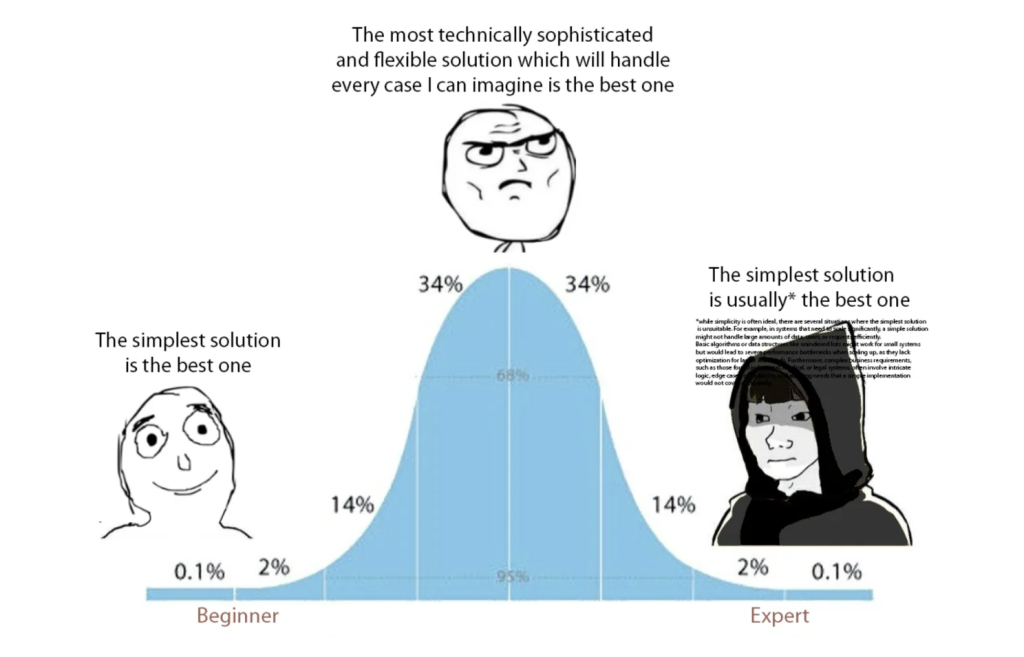
When Optimization Kills Agility
I’ve seen MVPs with advanced functionalities before speaking with a single user. Sales funnels with seven automated steps without having tested a single one manually. Small teams implementing full Scrum, with all its ceremonies, three management tools, and sophisticated metrics… to manage a backlog of five tasks.
Sometimes in startups we fall into the trap of demonstrating that we’ve mastered the stack and that we’re ready to scale, when in reality we still don’t know if anyone wants what we’re building. We automate, scale, integrate—everything—before having something that actually works.
We forget the most basic questions: who is this for? What’s the problem? Have we tested whether it solves it? And meanwhile, we invest time, energy, and money in processes that don’t add value… only complexity.
The result: systems nobody uses, processes nobody understands, and structures that feel robust but don’t deliver traction.
It’s as if someone gave me a Tesla with autonomous mode… but I live in a town where there isn’t even internet on the roads. What I need is a car that starts, gets me there, and doesn’t leave me stranded halfway.
Is It Worth Scaling Something That Hasn’t Been Tested?
A startup I worked with a year ago decided to invest €25,000 in automating their entire sales funnel. From acquisition to onboarding, including lead scoring, email marketing, and the tracking system. Everything worked… in theory.
The problem: their monthly traffic was 300 users. At a 2% conversion rate, that equaled 6 customers per month. Let’s assume they manage to improve to 3% with all this automation. That takes them to 9 monthly customers. An increase of 3 more conversions, which is very good… if it hadn’t cost €25,000.
In concrete numbers:
- The automation cost €25,000, not counting the monthly investment in advertising to generate traffic. During the first six months, the automated funnel generated an average of 9 customers per month. That is, 54 customers in total before they decided to partially deactivate it.
- That brings the acquisition cost to more than €460 per customer, considering only the technical cost. And if we add the advertising investment during those months—about €15,000 additional—the total acquisition cost dangerously approached €700 per customer, more than triple what they were paying before.
- All to gain barely 3 more conversions per month. A luxury that might be justified with 30,000 users per month. But with 300, it simply didn’t add up.
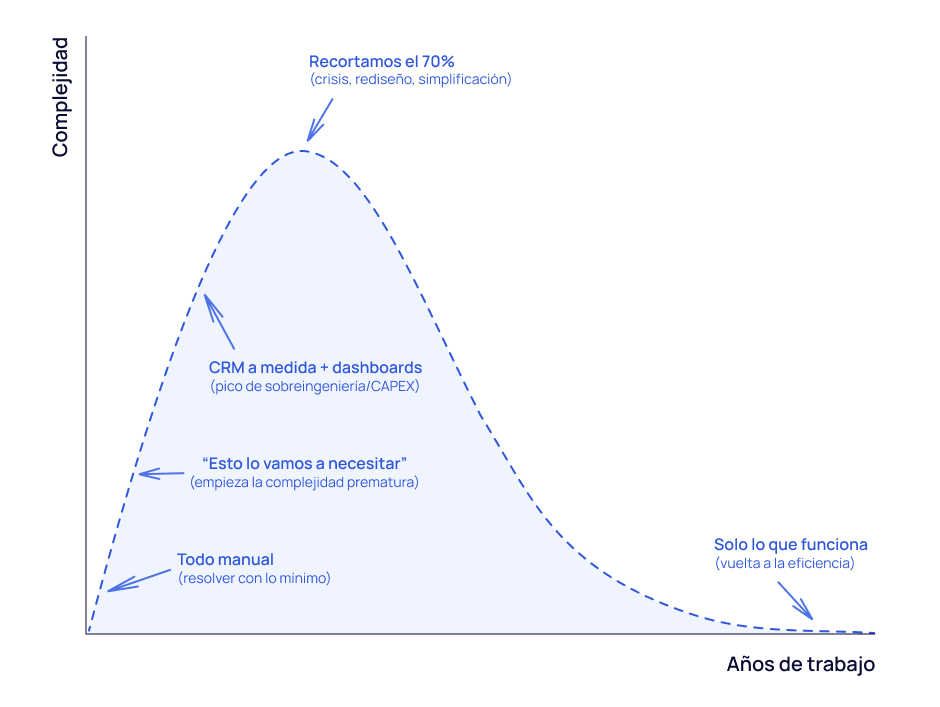
Being a high CAPEX, amortization depended on a sustained improvement in conversion… that never came. What ended up happening: six months later, they deactivated 70% of what they had built and returned to a manual process.
These types of mistakes don’t just drain resources. They also exhaust the team, complicate iterations, and turn every change into surgery.
Sometimes in startups we fall into the trap of demonstrating that we’ve mastered the stack and that we’re ready to scale, when in reality we still don’t know if anyone wants what we’re building.
The Mistake of Thinking in CAPEX When What We Need Is OPEX
In early stages, one of the most common mistakes is investing as if we were a large company. Enormous resources are allocated to custom developments, complex automations, or robust infrastructures—thinking we’re building something solid.
But what’s really needed in that phase is adaptability: simple tools, lightweight processes, and decisions that can be adjusted quickly.
- CAPEX (Capital Expenditure) is spending on big things: custom platforms, proprietary servers, automations that require months of development.
- OPEX (Operational Expenditure) is what allows you to operate day to day: tools, services, simple and flexible processes.
Investing heavily in CAPEX from day one is like building a logistics center for an online store that doesn’t have orders yet. The efficient approach is to start with just enough, test, and scale when necessary, not before.
Although in accounting CAPEX is “amortized” over time, in a startup without validation or traction, that time never comes. The asset becomes a burden before it returns value.
It Also Happens (A Lot) in Digital Marketing
Overengineering isn’t just a development or product problem. In digital marketing it’s also commonplace:
Technical SEO on sites without traffic, custom developments that could be solved with a CMS, and automation flows that complicate more than they help. All very brilliant, but it doesn’t move the needle.
We get so enthusiastic about the tools that we design solutions that, although technically impeccable, don’t align with the real needs of the business or the user.
And it doesn’t just happen with technology. There’s also organizational overengineering.
In many startups it appears in other less visible but equally costly forms:
- Process overengineering: complex frameworks for small teams. Sprints with all their ceremonies, metrics, tools, and dynamics more designed to scale than to validate.
- Tool overengineering: multiple work platforms that overlap, which ends up fragmenting information and duplicating effort.
- Reporting overengineering: wanting to measure everything from day one, when the most urgent thing is for something to work. Dashboards, KPIs, and reports when there still isn’t enough data to draw useful conclusions.
Organizational complexity also has a cost. In time, in motivation, in focus. And just like with the product, often what’s needed is less structure… and more clarity.
Obviously, nobody does it with bad intentions. In most cases, overengineering is born from the desire to get ahead of what could happen and be ready for any scenario.
The problem is that, nine times out of ten, that “just in case” never materializes. And meanwhile, we invest time and effort in something that doesn’t add real value. The worst part is that, along the way, we end up adding unnecessary complexity to the project, something we’ll then drag like an anchor throughout its entire life.
How Do We Avoid This Trap?
After working with early stage startups, scaleups, and also some that died along the way, I realized something: most problems are solved by returning to the simple: validate, iterate, measure. And repeat.
You don’t need magic answers. Going back to the basic questions is enough:
- Are we solving a real problem?
- Does our user need this… or are we doing it because we could do it?
- Is there a simpler version we can launch first?
- Are we thinking about scaling before having traction?
- And above all: would I do this if I had to pay for it out of my own pocket?
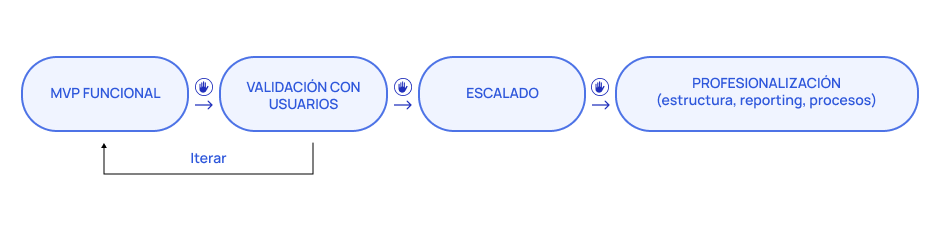
In summary: if your MVP doesn’t embarrass you a little, it’s probably not an MVP.
Build the ugliest thing possible that allows you to learn quickly. Adjust. Repeat. And only then, invest in making it beautiful, solid, and scalable.
Agility isn’t speed without control. It’s choosing wisely when to invest in complexity and when to simply solve. Let’s build less, validate more. And then, let what needs to scale, scale.