Historically, design has been treated as an add-on. A “nice extra” that comes at the end of the process to dress up whatever is needed. But in reality, design is a business tool. And here is the key: it does not only influence how something looks, but how it is perceived, how it is used, and ultimately, how much it sells.
If you lead a startup, manage a marketing team, or simply want to optimise your company’s digital experience, you may have already come across this dilemma:
“How can we assess and measure the impact of design on the business?”
The reality is that we are driven by results, and well-executed design can deliver measurable outcomes:
- Companies with a coherent visual identity can increase revenue by up to 33%. (Lucidpress)
- Companies that prioritise design grow twice as fast as their competitors. (Design Management Institute)
Because in the end, whether we like it or not, everything comes down to money. So designing better means optimising resources and ensuring revenue is not lost to unnecessary friction. So vamos to put the cards on the table: design is not just aesthetics; it is profitability. Or at the very least, we should start looking at it that way.
Now I am going to share a few key areas where design has a direct impact on the business.
Design and perceived value: the price people are willing to pay
The way a product or service is presented directly affects its perceived value. It is not only the value and how a product or service looks in itself, but how you communicate it and the experience you build around it.
Companies that invest in their visual identity and user experience not only sell more, but can also charge more without customers perceiving it as abusive or excessive.
Why? Because design reinforces the sense of exclusivity, quality, and trust.
- If the design is chaotic, the brand looks improvised.
- If an interface is confusing, the product seems difficult to use.
- If the visual identity changes constantly, the business looks unstable.
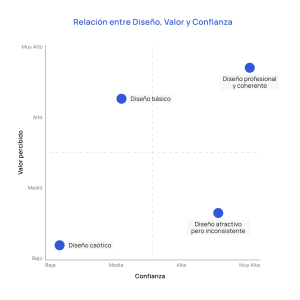
💡How does it impact the business?
- Justifying higher prices without customer resistance.
- Higher retention and lower churn.
- Stronger positioning in saturated markets.
Design as a competitive advantage in saturated markets
When all products look the same, design is what makes ours feel different. It is not just about being “pretty”, but about being clear, easy to use, and most importantly—and most complex—memorable. That is why the key is to understand that design is not an expense, but an investment in differentiation and scalability.
Design-led strategy allows us to:
- Reduce friction in decision-making. The more intuitive the user journey, the faster they will take action.
- Create a recognisable identity. If your branding is inconsistent or generic, you will be just another option in the pile.
- Make loyalty easier. A strong visual and functional experience makes people want to come back.
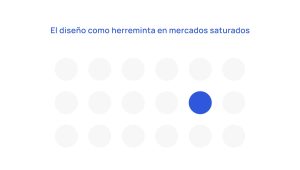
💡How does it impact business metrics?
- Lower customer acquisition cost (CAC).
- Higher retention and lifetime value (LTV).
- Greater ability to expand into new markets.
Design and conversion: moving from aesthetics to results
Attractive design is useless if it is not built to convert. Poor design can make you lose customers before they make a decision.
88% of users will not return to a website after a poor user experience. (Toptal)
It is not just about placing eye-catching buttons or choosing the colours we consider most suitable, but about structuring information so that it guides the user to action without friction. Every design element should be intended to guide the user towards the conversion we want them to complete. Design must work with user psychology, not against it.
- Visual hierarchy matters. If the user does not understand what to do in the first few seconds, we have lost them.
- Consistency builds trust. Changing tone or design at every touchpoint creates unnecessary noise.
- Clarity sells more than creativity. It is not about being the most innovative, but the easiest to understand.
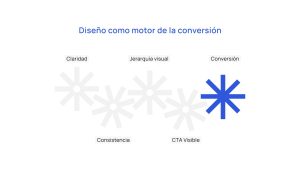
💡How does it impact the business?
- Higher conversion rate and lower bounce rate.
- Higher return from Paid Media campaigns.
- Funnel optimisation without increasing acquisition spend
Design for efficiency and scalability
Design does not only impact perception and conversion; it also affects how a company’s internal processes are run. This is where we could open the can of worms of Design Ops, but I think that is for another edition.
A poorly designed product, process, or interface in an internal tool can cause a team to lose hours every week trying to figure out how to use it. A poorly structured visual system can make implementing new processes a headache—and they may never end up being implemented and working.
Companies that integrate design, or a “design mindset”, into their operations gain advantages that directly impact day-to-day work, such as:
- Less friction in tool adoption.
- Fewer operational errors.
- Greater scalability without having to redo processes.
If you think about it, design is also a support tool for other teams, and this can impact costs quite significantly.
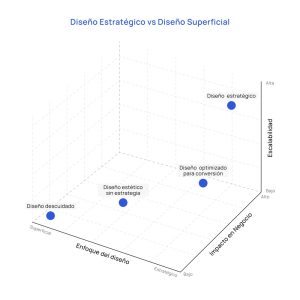
💡How does it impact the business?
- Lower operating costs.
- Higher team productivity.
- Greater ease of scaling without friction.
Design and business cannot be separate worlds
A carpenter without a good hammer, a mechanic without a precise spanner, or a chef without a well-sharpened knife could keep working, yes, but with more effort, less precision, and worse results. Do you agree?
The same applies to business-focused design. It is not an extra or an aesthetic whim; it is the tool that enables us to structure, clarify, and optimise what we are trying to communicate. When used strategically, it does not just make everything work a bit better—it becomes a key asset for growth and profitability.
So remember that investing in well-executed design enables you to:
✔ Justify higher prices and strengthen brand perception.
✔ Reduce CAC and improve conversion.
✔ Increase operational efficiency and make it easier to scale campaigns and the business.
📌And to wrap up completely, ask yourself the following questions:
Does your branding reflect the positioning you want to convey?
Does your product or website guide the user clearly, or does it make them work too hard?
Do your internal tools work and are they efficient?
If any of these questions raise doubts, it is time to pause and rethink.
If you would like us to review it together, contact us.